Panama is entering 2026 with positive signals from economic activity.
According to PanamaTimes, Panama’s Monthly Economic Activity Index (IMAE) increased by 5.19% in May 2026 compared with the same period last year. The increase was supported by construction activity, maritime trade and domestic consumption.
Notably, this is not a single isolated growth figure.
According to official data from the Instituto Nacional de Estadística y Censo (INEC), the IMAE in May 2026 increased by 5.19% according to the original series and by 5.06% according to the cycle trend. Meanwhile, Panama’s GDP in the first quarter of 2026 increased by 4.8% compared with the same period last year.
These figures show that Panama’s economy is maintaining a relatively positive growth rate in 2026.
Three key drivers of Panama’s economy
Construction continues to play an important role
Construction activity is one of the sectors supporting the recovery of Panama’s economy.
The development of infrastructure, real estate and urban projects creates demand across many related industries, while also contributing to economic activity in urban centers.
For international investors, the development of construction and real estate is also noteworthy because these sectors are directly linked to the expansion of cities and demand for housing, accommodation, commercial space and services.
The maritime position continues to create an advantage
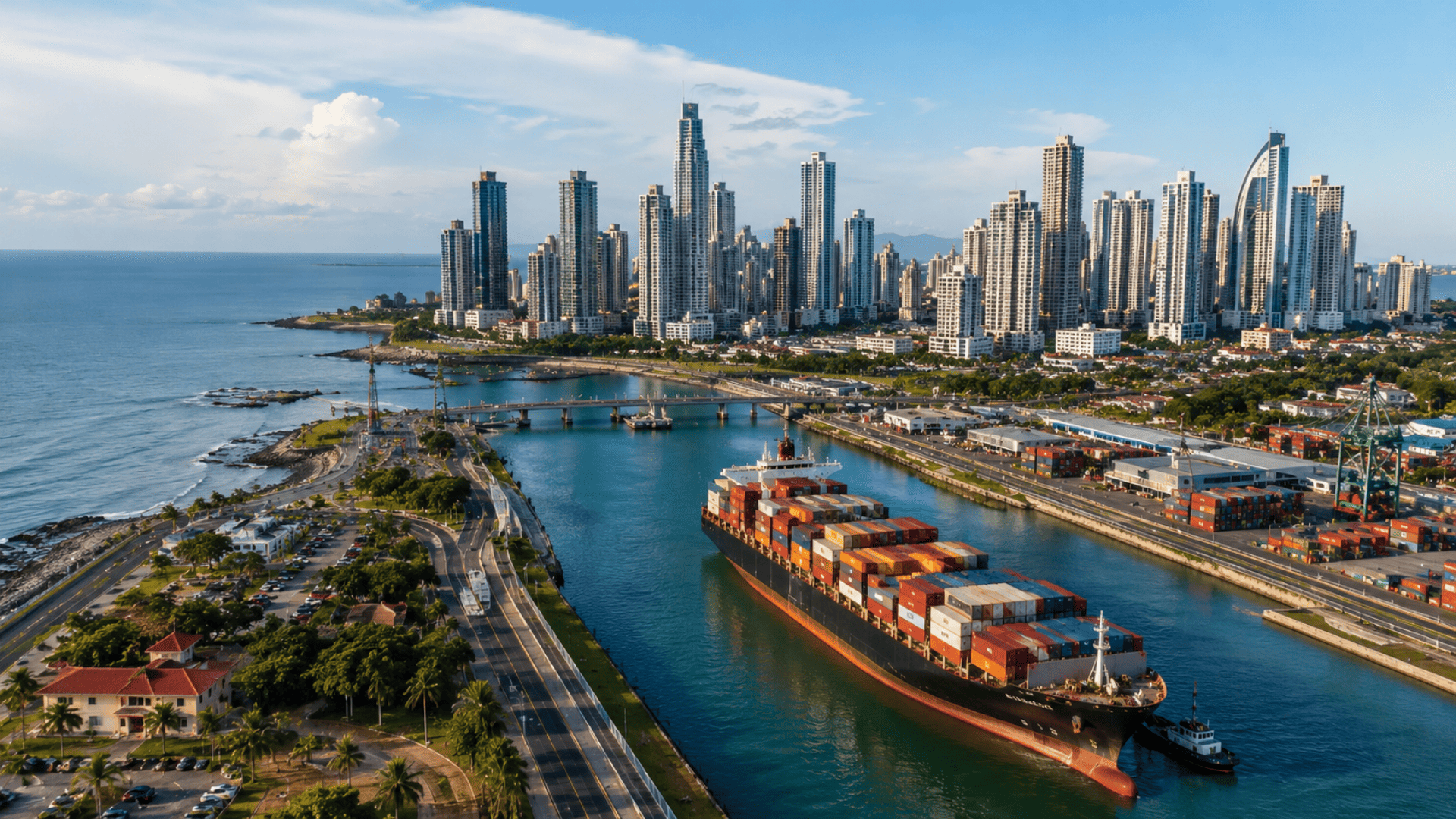
Panama possesses one of the world’s most distinctive geographical advantages thanks to its position connecting the Atlantic and Pacific Oceans.
The Panama Canal, together with the port system and logistics activities, allows the country to maintain an important role in international trade.
Therefore, growth in maritime activity is not only significant for the transportation sector but also creates spillover effects across logistics, trade, services and real estate.
Domestic consumption is improving
Alongside sectors oriented toward international markets, domestic consumption is also a factor supporting growth.
As economic activity improves, demand for retail, services, housing, accommodation and commercial activities also has greater conditions for expansion.
This creates a more diversified economic foundation rather than one that depends entirely on a single sector.
Another noteworthy point: Inflation is very low
If investors only look at the growth rate, they may overlook another important macroeconomic factor in Panama: the price level remains low.
According to INEC, Panama’s Consumer Price Index (CPI) decreased by 0.3% in June 2026. The CPI compared with the same period last year also decreased by 0.2%.
This creates a rather distinctive picture:
- IMAE in May 2026: +5.19%
- GDP in the first quarter of 2026: +4.8%
- CPI in June 2026: -0.3%
In other words, Panama is recording positive economic activity growth while pressure from consumer price increases remains relatively low.
However, it should be noted that a negative CPI does not mean that all types of assets or all costs in the economy are falling in price. CPI reflects changes in a basket of consumer goods and services; the price movements of real estate, rents or construction costs may differ from the overall CPI.
For investors, this is why it is necessary to look simultaneously at growth indicators, inflation, the real estate market and capital flows rather than relying on a single figure.
From economic growth to real estate opportunities
What makes the above data particularly relevant to international investors is the relationship between economic growth and demand for real assets.
When construction, maritime trade and consumption all expand, demand for different types of real estate serving:
- Housing;
- Hotels and accommodation;
- Offices;
- Commercial space;
- Services;
- Logistics;
may also benefit from the economic development process.
In particular, Panama City is increasingly playing an important role in the region’s financial, commercial and services ecosystem.
Therefore, for international investors, the Panama story is not only about GDP growth but also about the ability to translate economic growth into long-term asset value.
Panama is becoming a market worth watching
An attractive international market does not necessarily have to be the largest economy.
What matters more is its ability to connect with capital flows, international trade and high-value economic activities.
Panama possesses several distinctive factors:
- Strategic location between two oceans
- Panama Canal
- Port and logistics system
- USD-based economy
- International financial system
- Developing real estate market
Combined with 5.19% IMAE growth and 4.8% first-quarter GDP growth, these factors are creating additional grounds for Panama to continue being monitored as a market with potential within international investment strategies.
Residency opportunities in Panama through the Strategic Investor Program
Alongside positive signals from the economy, Panama also attracts international investors through the Strategic Investor Program (Qualified Investor Visa).
The program provides an approach that combines asset investment and residency rights in Panama, suitable for investors looking for a new market to diversify their asset portfolio and build a long-term plan for their families.
A noteworthy point is that Panama is not chosen solely because of its residency policy, but also because of the country’s economic foundation and international position. With the USD, an international financial system, its role as a logistics hub and its location connecting North and South America, Panama is becoming a market worth noting in cross-border wealth management strategies.
For investors, this creates a different approach: instead of viewing residency rights as the final objective, an investment can be assessed simultaneously based on asset value, utilization potential, cash flow and long-term growth potential.
Pullman Panama: An asset connected to the international tourism and services ecosystem
One of the real estate options introduced by Casa Seguro Capital in Panama is the 5-star Pullman Hotel & Residences, a high-end real estate complex in Panama City, developed to international standards and operated under the Pullman Hotels and Resorts brand. The project combines a 5-star hotel, serviced apartments and a range of entertainment amenities, targeting business travelers, high-end tourism and long-term accommodation.
The project consists of 27 floors with 180 hotel rooms and 126 apartments, together with amenities such as a casino, restaurants, bars, a swimming pool and rooftop amenities. Its location on Ricardo Arias Avenue provides access to the commercial areas, offices and financial center of Panama City.
Investors can access the project through two forms. The first option is co-ownership of a 5-star hotel from USD 300,000, suitable for a passive investment strategy when the asset is operated by an international operator. The second option is ownership of a high-end apartment from USD 360,000–400,000, with an area of approximately 50–85 m² and the possibility of participating in a professional rental program with an estimated return of 5–6% per year.
What is noteworthy about Pullman Panama is that the asset is positioned within an ecosystem with existing demand from tourism, business travelers, international professionals and commercial – financial activities. This is also why the hotel and serviced apartment model can become an option worth considering for investors seeking to combine residency rights with an international asset ownership strategy.
Casa Seguro Capital’s perspective
At Casa Seguro Capital, we believe that evaluating an international real estate market should begin with its economic foundation, rather than simply looking at prices or a residency program.
The important questions that need to be asked are:
- How is the market growing?
- Where are capital flows going?
- How is infrastructure changing?
- Does real demand for housing and accommodation actually exist?
- Does the asset have the ability to generate returns over the long term?
This is also how Casa Seguro Capital approaches the Panama market: not only looking at residency rights, but simultaneously assessing the economy, location, real estate, asset utilization potential and international wealth management strategy.
The latest figures from Panama show that the economy is maintaining positive growth momentum, while inflation remains low.
For international investors, this may be a signal worth continuing to monitor: when an economy grows, the important question is not only how quickly Panama is developing, but also which assets have the potential to benefit from that growth cycle.