
In a context where the European economy continues to face many uncertainties, Portugal remains one of the most notable markets in Southern Europe.
No longer a story of an economy recovering from crisis, Portugal is now entering a more mature development phase, driven by domestic consumption, investment, EU funding, the labor market, and export activity.
For international investors, the key question is not only GDP growth, but also:
What are the underlying drivers of the Portuguese economy, and how can international capital access this market?
The economy continues to grow, but in a more sustainable direction
According to the OECD, Portugal’s real GDP is forecast to grow by 1.8% in 2026 and 1.7% in 2027.
The OECD states that growth in 2026 will be supported by disbursements from the Recovery and Resilience Plan (RRP), a relatively tight labor market, fiscal support policies, and a gradual recovery in external demand.
Meanwhile, earlier OECD projections at the beginning of the year had expected 2.2% growth for 2026, showing that the current outlook has been revised more cautiously due to risks from energy prices, international trade, and geopolitical instability.
This is not necessarily a negative signal.
It shows that the Portuguese economy is entering a phase where the quality and sustainability of growth become more important than pursuing excessively high growth rates.
EU capital flows continue to play an important role
One of Portugal’s notable advantages is its access to European Union funding and investment programs.
According to the OECD, the disbursement of funds under the Recovery and Resilience Plan is currently contributing to investment growth in Portugal.
This is highly significant for the economy, as these funds not only support public spending but also target sectors capable of generating productive capacity and long-term growth.
Investments related to digital transformation, energy, infrastructure, business development, and the green transition can create spillover effects across many other sectors of the economy.
In other words:
EU funds → investment → infrastructure → businesses → jobs → growth.
This is one of the key driving chains helping Portugal maintain its attractiveness to international capital flows.
The labor market remains a pillar of support
Another important factor is the labor market.
According to European Commission forecasts, Portugal’s unemployment rate is expected to decline slightly from 6.0% in 2025 to 5.9% in 2026, before further decreasing to around 5.8% in 2027.
A relatively stable labor market helps strengthen household purchasing power and supports domestic demand.
This is also an important factor for investors interested in assets in Portugal, as the value of a market does not only come from international capital flows but also from real domestic economic demand.
Inflation remains a factor to monitor
If growth is one side of the economic picture, inflation is the other.
According to Banco de Portugal, the March 2026 forecast suggests that inflation in Portugal could rise to around 2.8% in 2026.
The OECD, in its June 2026 forecast, even warns that inflation could reach around 3.2% in 2026, mainly due to higher energy prices.
This means investors should not look only at GDP growth.
An investment market must be assessed simultaneously through:
Economic growth
Inflation
Interest rates
Labor market
Capital flows
And the ability to generate real asset value.
It is the balance between these factors that determines the long-term attractiveness of an economy.
Portugal still holds a special position in the European ecosystem
One of Portugal’s greatest advantages is not the size of its economy.
Its strength lies in its position within the European Union and the European single market.
Investors access an economy within the Eurozone while also being able to connect to the broader EU market.
In addition, Portugal continues to develop sectors such as services, tourism, technology, renewable energy, and export-oriented industries.
According to Statistics Portugal, GDP at constant prices continues to record year-on-year growth, showing that the economy is still expanding even as growth rates return to a more stable level.
This is an important point for international investors:
It is not necessary to look for the fastest-growing economy. More importantly, it is about finding an economy capable of sustaining growth and connecting to long-term capital flows.
When real estate is no longer the investment route
An important change in Portugal’s investment migration market is that real estate is no longer an eligible option for the Golden Visa as it was before.
Following legal changes in 2023, the program shifted its focus to other forms of investment.
Among them, investment in eligible funds starting from EUR 500,000 has become one of the most prominent options for international investors.
This creates a completely different approach.
Instead of directly owning a house or property, investors can access the Portuguese economy through an investment in an eligible fund.
Portugal Golden Visa through fund investment
With the fund investment route, investors are required to make a minimum investment of EUR 500,000 into a fund that qualifies under the program’s regulations.
This approach aligns with the increasingly common trend in modern investment migration:
Not only purchasing an asset to obtain residency rights, but using a financial investment to simultaneously access the market and build a long-term wealth strategy.
An important point is that funds differ in structure, investment strategy, risk level, and liquidity.
Therefore, investors should not focus only on the figure of EUR 500,000.
More importantly, they must evaluate:
- Which sector does the fund invest in?
- What is the investment strategy?
- What is the legal structure?
- What are the risk and liquidity levels?
- What is the fund’s track record?
- Does the investment meet Golden Visa requirements?
This is why fund selection must be considered as a financial investment decision, not merely an immigration procedure.
Why choose Mercan Private Equity Fund II for the Golden Visa program?
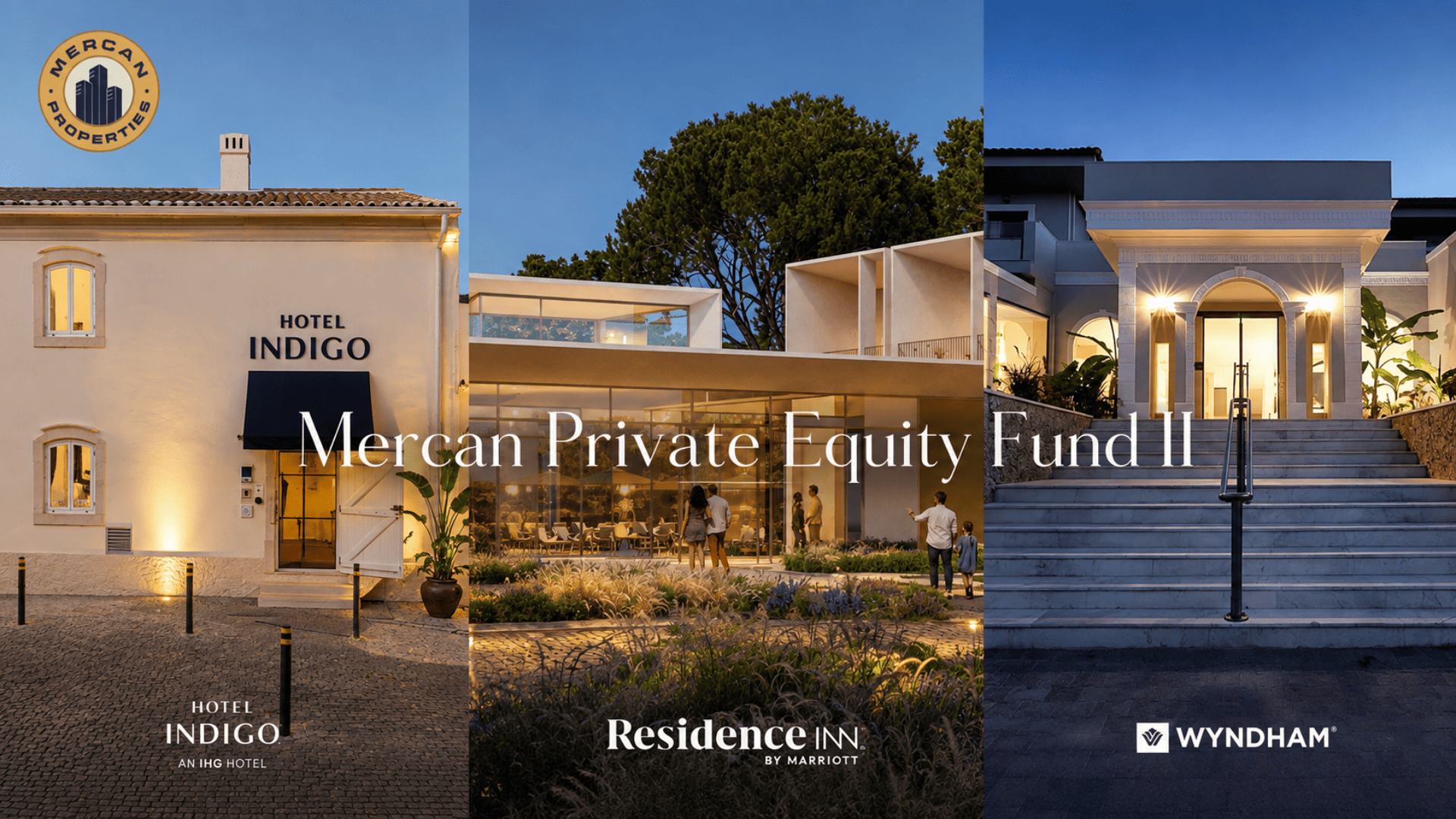
Among the eligible fund options for the Portugal Golden Visa program, Mercan Private Equity Fund II stands out as a solution specifically designed for international investors seeking a combination of residency, legal security, and long-term investment strategy.
Unlike conventional investment funds in the market, Mercan Private Equity Fund II is developed within the ecosystem of Mercan Group – an entity with long-standing experience in investment, development, and operation of hospitality projects in Portugal.
This creates a key advantage: the fund is not purely financial in nature, but is directly linked to real assets and economic projects actively operating within the Portuguese economy.
1. Linked to real economic projects in the hospitality sector
One of the core differences of Mercan Private Equity Fund II is its investment strategy focused on hotel and commercial real estate projects in the hospitality sector – one of the most important and stable industries in Portugal.
In particular, many projects in the portfolio are operated by leading international hotel brands such as Marriott, IHG (InterContinental Hotels Group), and Wyndham. This ensures professional operational standards, stable performance, and sustainable attractiveness from international tourism flows.
Instead of fragmented or speculative investments, the fund focuses on assets with:
- Real operating cash flow from hotel operations
- Stable and long-term growing tourism demand in Portugal
- Participation of global hotel management brands such as Marriott, IHG, and Wyndham
- Tangible assets with clear economic utility and value
This allows investors to access a model based on real assets rather than purely financial market fluctuations.
2. Aligned with Portugal’s economic development direction
As analyzed, one of the key drivers of the Portuguese economy is tourism, services, and sectors related to international consumption.
Mercan Private Equity Fund II’s focus on hospitality allows the fund to:
- Align with the structure of economic growth
- Directly benefit from international tourism flows
- Leverage the long-term development trend of Portugal’s service sector
- Integrate into an ecosystem operated by global hotel brands such as Marriott, IHG, and Wyndham
This creates a strong alignment between fund strategy and macroeconomic fundamentals, which is essential for long-term investment.
3. Clear investment structure, compliant with Golden Visa requirements
Mercan Private Equity Fund II is designed to fully meet Golden Visa program criteria, including:
- Minimum investment threshold (EUR 500,000)
- Transparent legal structure
- Eligible investment portfolio under the law
- Professional management and monitoring process
For investors, this helps reduce compliance risk – one of the most important factors when participating in investment-based residency programs.
4. Mercan Group’s operational experience
Mercan Group is an entity with long-standing experience in:
- Developing real estate and hotel projects in Portugal
- Partnering with international hospitality operators such as Marriott, IHG, and Wyndham
- Managing and implementing investment structures for international investors
This experience allows Mercan Private Equity Fund II to be not just an investment fund, but part of a real operational value chain in the hospitality and tourism industry.